
March 2026 - June 2028
To ensure Ottawa’s south west region has the power to grow, Hydro Ottawa Limited (Hydro Ottawa) has initiated a federal environmental assessment for a new 27.6 kV municipal transformer station in south Nepean.
This work is being undertaken to support a Government of Canada construction project that is scheduled to take place over the next several years at the Canadian Food Inspection Agency (CFIA) Fallowfield Road campus; identified on the Canadian Impact Assessment Registry as the Regulatory and Security Sciences (RSS) Main Hub project. As it exists now, the electrical infrastructure in the area does not have the capacity to provide adequate supply for the project and the surrounding communities.
What will this project include?
The Greenbank municipal transformer station project proposes:
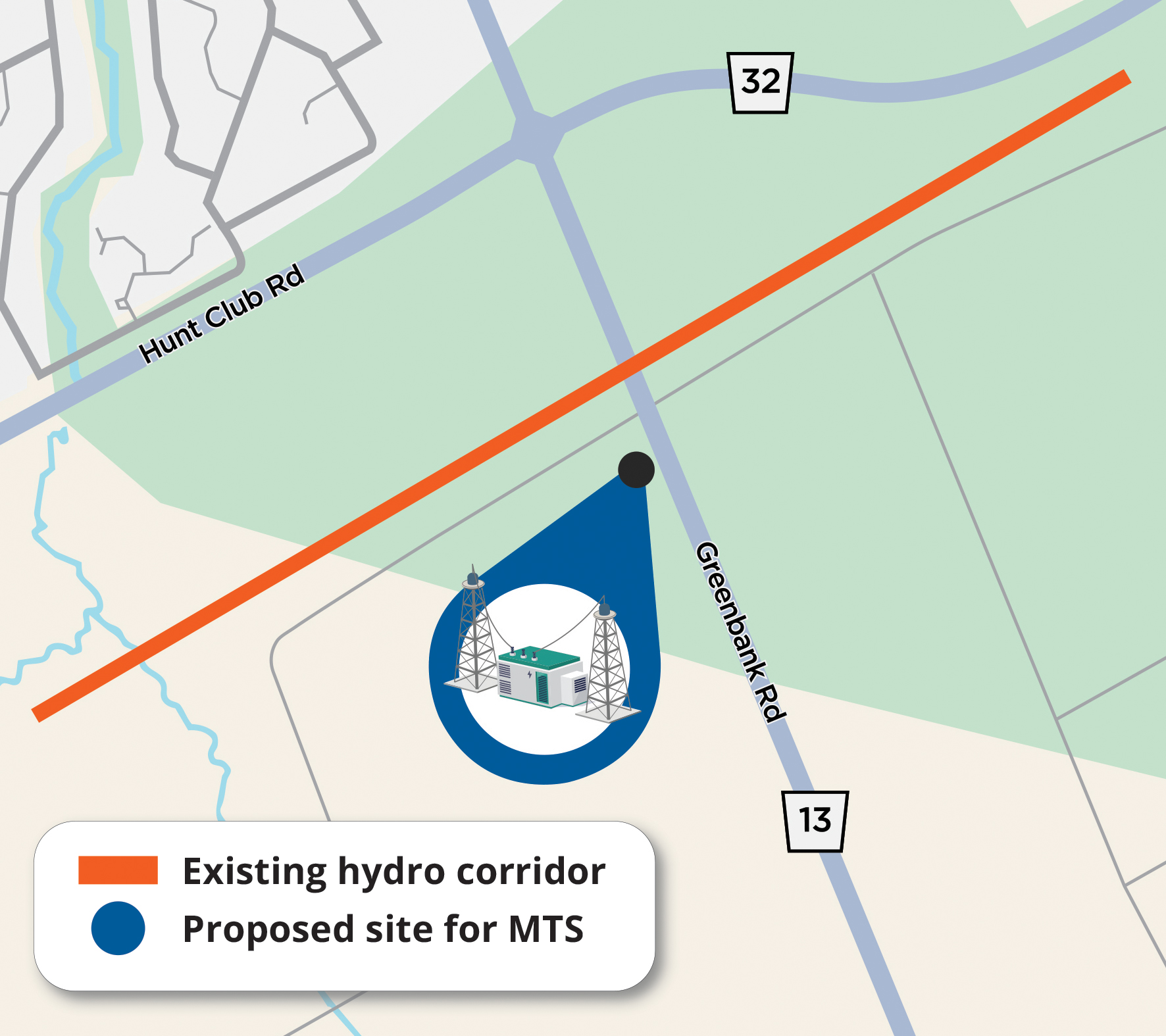
- To construct a new 27.6kV municipal transformer station (MTS) on Greenbank Road, approximately 450 metres south of the Hunt Club Road intersection.
- To connect the new power station to Hydro One’s existing 230kV transmission line located on federal lands north of the proposed site.
The station, to be constructed within the National Capital Region greenbelt, will serve existing customers and support projected growth in electricity demand for new residential and commercial developments in south Nepean for many years to come. It will enhance reliability, reduce the size and frequency of outages, and provide redundancy to the area’s electricity system in the event of future extreme weather events.
Why we are moving forward with this project
The Greenbank municipal transformer station is one of many future-planning investment projects we are spearheading to support growth and grid resilience, and to make our electricity system as sustainable as possible.
The need for new facilities was identified through the Sub-Region Integrated Regional Resource Plan (IRRP) for the Ottawa region. Released in July 2025, the IRRP is a twenty-year plan that has been developed by a regional planning working group consisting of the Independent Electricity System Operator (IESO), Hydro Ottawa and Hydro One.
We look forward to speaking with you
Consultation is an important part of the federal environmental assessment process and our commitment to keeping our customers informed. As such, you are invited to attend one of our upcoming community information sessions to learn about the project, speak directly to members of our project team, and provide your feedback.
Community Information Session 1
April 28, 2026
12:15 p.m. - 1:00 p.m.
Click here to register for the afternoon session
April 28, 2026
6:45 p.m. - 8:30 p.m.
Charlie Conacher Community Building
30 Wessex Road, Nepean
In the event you aren't able to attend our virtual or in-person information sessions for the Greenbank municipal transformer station project, the link below will take you to the most commonly answered questions.
Contact
If you have questions about the project, please email us at [email protected].
FAQs
A municipal transformer station (MTS) “steps down” the voltage of the electricity being delivered by a high-voltage transmission line to a lower voltage that is suitable for distribution to local customers. Distribution lines are generally on wood poles along the road allowance, and may also be underground in some areas.
In July 2025, the need for a new station was identified in a twenty-year Integrated Regional Resource Plan.
The Greenbank municipal transformer station is being undertaken to support a Government of Canada construction project that is scheduled to take place over the next several years at the Canadian Food Inspection Agency (CFIA) Fallowfield Road campus; identified on the Canadian Impact Assessment Registry as the Regulatory and Security Sciences (RSS) Main Hub project. As it exists now, the electrical infrastructure in the area does not have the capacity to provide adequate supply for the project and the surrounding communities.
Until recently, Hydro Ottawa built a new substation every five to seven years. Now, we are on track to energize a new station nearly every year until 2030.
Hydro Ottawa’s support for this project is intentionally designed to benefit the wider community by supplying additional capacity that will improve local service, provide redundancy to our system in the event of future extreme weather events, and support projected growth in the surrounding south Nepean area.
A reliable source of electricity is essential to supporting community growth - powering homes, schools, businesses, and transportation.
Contingent on the federal environmental assessment and other approvals, the new Greenbank 27.6kV municipal transformer station (MTS) will be constructed within the National Capital Region greenbelt on Greenbank Road, approximately 450 metres south of the Hunt Club Road intersection, and in close proximity to the existing Hydro One 230kV transmission corridor located on federal lands north of the proposed site.
The Integrated Regional Resource Plan is a twenty-year plan that has been developed by a regional planning working group consisting of the Independent Electricity System Operator, Hydro Ottawa and Hydro One.
Regional system planning ensures a reliable supply of electricity to regions across the province and considers a range of solutions including conservation, generation, transmission and distribution, as well as other resource options to ensure that electricity is available when needed.
A project of this scale can take several years from initial planning until completion. There are many steps involved including development work, the federal environmental assessment process and other approvals, and construction.
Hydro Ottawa’s role is to support the Government of Canada’s construction project and long-term operational needs by providing adequate electricity supply, as per our Conditions of Service. Hydro Ottawa’s construction work (our portion of the CFIA project) will take approximately two years to complete, with a target in-service date for the new Greenbank station by the end of 2028.
The project will not require the removal of any trees. Any enhancement measures will be thoughtfully considered in accordance with the recommendations of the federal environmental assessment and input from the local community.
Site enhancements could include tree planting, vegetation buffers, decorative and community-friendly fencing, and/or an earth berm along the frontage of the site. These elements will serve to visually mask the municipal transformer station while dampening operational noise and vibration.
Yes. As a utility, we plan decades ahead and consider Ottawa’s unique electricity needs, including strengthening our own distribution network and infrastructure. We also look at new opportunities and innovative technology like distributed energy resources that can help build redundancy.
From a climate and planning standpoint, Hydro Ottawa considers recent years and events that point towards a new reality requiring contingencies to better protect the electricity grid, our systems and our customers.
Further consideration is also given to meeting greenhouse gas reduction targets set by various levels of governments (plus our own sustainability goals), as well as a future of mass electrification.
We are spearheading a lot of future planning to make the electricity system as sustainable and resilient as possible.
In 2025, Hydro Ottawa customers had power an average of 99.97 per cent of the time. Major weather events can shake customers’ trust in the reliability of the system and stoke fears of lengthier power outages in the future. As such, Hydro Ottawa is building and investing in a more resilient and modernized grid with new technology to mitigate these risks.
The federal environmental assessment is a streamlined process to ensure that this transmission facility project with a known range of effects is planned and executed in an efficient and environmentally responsible way.
A key principle of the Impact Assessment Act (IAA) is co-operation with other jurisdictions, such as provinces, territories and Indigenous communities.
As part of the federal environmental assessment process, phases one and two of the Government of Canada’s RSS Main Hub project have been posted on the Canadian Impact Assessment Registry. The notice of determination for both phases was determined to not likely cause significant adverse environmental effects, allowing the process to proceed.
- A federal environmental assessment) takes a broad and all-encompassing view of the environment. Potential effects of the project will be examined through a number of detailed studies, taking into consideration factors relating to:
the natural and socio-economic environments; cultural/heritage resources; recreational resources; existing and planned land uses; visual landscapes; technical/cost considerations; and the concerns and interests of local business and residential property owners, Indigenous communities, government agencies and other interested parties. - A number of natural environment field studies will be undertaken in the project area as part of the process. This will include:
Species at Risk (SAR) surveys, as required by government agencies; Ecological Land Classification; botanical and tree surveys; aquatic habitat assessments; incidental wildlife observations; and, potential significant wildlife habitat mapping. Where effects on the natural environment cannot be avoided, appropriate mitigation measures will be proposed.
As of December 2025, independent environmental consultants completed field work, including soil sampling, and are in the process of drafting an environmental study assessment. These pro-active studies were conducted to determine the technical and environmental suitability of the 4-acre parcel of land where the new station will be constructed in order to satisfy the NCC and federal impact assessment.
To provide sufficient electrical capacity to support growth in the south Nepean area, the current plan is to have two transformers at the new station, similar to the size of our Piperville municipal transformer station in the southeast end of the city. Specific information about the design of the new station is not available at this time as this will be developed during the environmental assessment.
Many factors are taken into consideration when planning projects of this size, including feasibility, cost, reliability, and seeking to maximize the use of existing electricity infrastructure, where possible. These decisions are not taken lightly, and above all, are always made with our customers in mind.
As per the Distribution System Code, any customer requesting more than 5 MW of electrical load must contribute financially to the station upgrade work required to connect the load.
A more detailed cost estimate will be developed by Hydro Ottawa as it moves through the project approval process and undertakes detailed engineering and designs for the facilities.
Yes. As part of our sustainability commitments, Hydro Ottawa intends to develop Greenbank as a lower carbon substation.
This is one of five Hydro Ottawa station projects using the latest in innovative designs to reduce embodied carbon. Building on that experience, we are planning this station's construction to incorporate advanced technology, procurement, and construction techniques, using lower Global Warming Potential (GWP) materials and equipment to address the carbon footprint associated with the substation's construction and operation.
Yes. This is currently being reviewed. Additional generation can connect either to the new station or directly to the connection line. It is possible for renewable generation and other innovative technologies, such as energy storage and distributed energy resources, to provide additional power in order to address the area’s need. We will share more information on this as it develops in the future.
Ontario’s electricity sector is one of the cleanest in the world, producing nearly 87 per cent of electricity completely free of GHG emissions.
Electric and magnetic fields (EMFs) are invisible forces that surround all electrical appliances and equipment, power cords and wiring found in your home. This is the same for outdoor power lines and equipment operated by utility companies. These fields are at extremely low frequency. The field strength is strongest close to its source and fades rapidly as you move away from the source.
Hydro Ottawa defers to Health Canada on the issue of EMFs. Health Canada does not consider that any precautionary measures are needed regarding daily exposures to EMFs at extremely low frequencies.
There is no conclusive evidence of any harm caused by exposures at levels found in Canadian homes and schools, including those located just outside the boundaries of power line corridors.
Once the design for the new MTS is determined, Hydro Ottawa will be able to project how EMFs might change.
Understanding that any construction activities can be very disruptive, we want to assure residents that all construction activities and any possible power interruptions will be scheduled and planned very carefully.
During the station’s actual construction phase, local residents may see various types and frequencies of construction traffic depending on the stage of the construction. There will not be a sustained long-term traffic impact specifically associated with the Greenbank station.
Further, to ensure the safety of the public and our crews as a result of the work required for this project, the majority of the work will be completed weekdays between 7 a.m. and 5 p.m., and in accordance with City of Ottawa noise by-law.
Over the course of this project, some customers may experience one or two planned power outages.
If there is a need for a planned power outage, we provide our customers with as much notice as possible. This includes notifications by phone, text and/or email depending on the account contact information we have on file, as well as hand-delivered letters where applicable.
We considered a number of other properties in our selection process. The criteria we evaluated included, but was not limited to, alignment with city planning, environmental stewardship, proximity to Hydro One’s existing transmission corridor, and system reliability.
Several sites were considered given the magnitude and timing of the cumulative capacity needed, driven by the Government of Canada customer load request. Given the area outside of the Greenbelt is mostly fully developed, it was determined that a new 27.6 kV municipal transformer station was required.